
Swages
Dies for hand forging. (Made of material C 45, unless otherwise stated)
Upper parts without handle, lower parts with shaft for insertion into the anvil.
Standard dies for hand forging such as anvil-horn, anvil-hardy, anvil-fork, etc. are usually made of the material C 45 (unless otherwise stated). Dies with a delicate cutting contour are usually made of hot-work steel to enable a longer service life.
The dies are divided into:
- Upper/Top swage (without handle)
- Lower/Bottom Swage (with shaft for insertion into the anvil or the perforated plate)


, DIN 5107, without handle Used for cutting warm forging material.

tungsten alloyed steel, blade width approx. 55...60 mm, total length ca. 195 mm, without handle. Used for cutting warm forging material.

DIN 5107, without handle. Used for cutting cold forging material.

tungsten alloyed steel, blade width ca. 45 mm, total length ca. 195 mm, without handle.


without handle The classic tool for driving through/punching/punching Features: forged made of tool steel robust professional quality produced in Germany Tip: The handle should not be wedged but should sit loosely to prevent recoil. Supplied without handle; this is available as an accessory.

without handle The classic tool for driving through/punching/punching Features: forged made of tool steel robust professional quality produced in Germany Tip: The handle should not be wedged but should sit loosely to prevent recoil. Supplied without handle; this is available as an accessory.

without handle. The Square flatter hammer: A tool for smoothing surfaces The Square flatter is used to smooth the surface of the workpiece and remove any unevenness. To do this, the workpiece is heated to red heat or the residual heat is utilized. The workpiece is then placed flat on the anvil track. The hammer operator places the smoothing hammer on the workpiece, while the striker strikes the smoothing hammer with quick, targeted blows. To achieve a particularly smooth surface, the hammer and anvil can also be moistened with water. However, all scale should be removed from the workpiece beforehand. Tip: The handle should not be wedged but should sit "loosely" to avoid impact impacts.


The finishing hammer is used for smoothing forged surfaces and for precise alignment. It is fixed in the square hole, and its ground face provides a flat surface for accurate results. Application: Smoothing and aligning (e.g., knife blades) while hot after rough forging. Function: Eliminating structural irregularities for a clean surface finish Fixation: In the square hole of the anvil or vise Special feature: Flat, ground working face Tip: Ideal for straightening knife blades or when the anvil face is worn.


Ball swage hammer 1,0 kg length approx. 150 mm, without handle

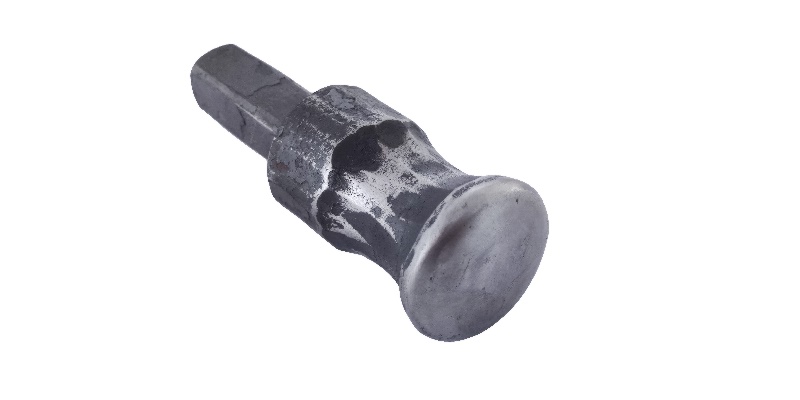
forged of tool steel, diameter #Varinfo shaft approx. 25x25 mm, for fixation in the anvil. other diameters on request

forged of tool steel, diameter #Varinfo shaft approx. 25x25 mm, for fixation in the anvil. other diameters on request

for own forging material C 45, for tempering in water